


AI Projects in 2026: Where Companies Stand and What This Means for AI Training in 2027
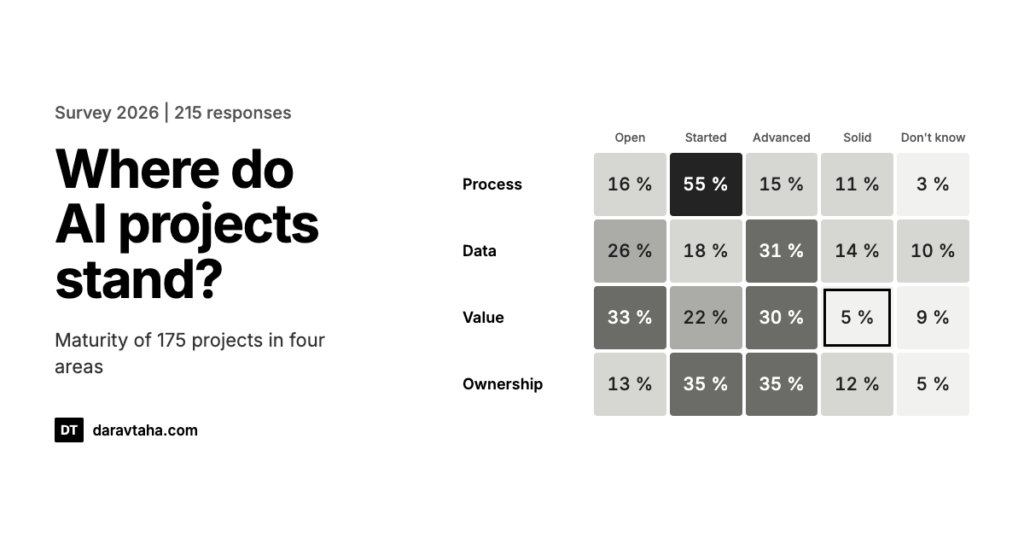
Where do AI projects in companies really stand? To find out, I surveyed 215 participants and compared their responses with my projects from 2025 and 2026. This article shows what I found and what it means for selecting AI training programs and AI projects in 2027. It is aimed at HR professionals, executives, and anyone involved in making AI-related decisions within their organizations.
I like to say in my training sessions: “We trust in God; everyone else should bring data.” That’s why I conducted a brief assessment this year. Five questions, 215 participants, and some interesting insights.
The most important points in brief
- Nearly half are in the early stages. 48.6% of the projects are in the concept or planning phase, and just over a quarter (26.9%) are already in daily operation.
- There is almost always a lack of evidence regarding benefits. Only 5.1% have assessed baseline values, goals, and costs. Of the 47 projects already in daily operation, only 3 have done so.
- Processes are usually only roughly understood. For 54.9%, the process is roughly outlined. Only 11.4% have documented it and coordinated it with the stakeholders.
- The data is rarely verified. 14.3% have verified its access and quality, while 26.3% have not yet verified the data.
- Responsibility often falls on individuals. 48% of projects are carried out as individual initiatives or without clearly defined responsibilities.
- When it comes to AI readiness, no one is fully prepared across the board. Not a single person has reached the highest level in all four areas.
| Open | Started | Far | Resilient | Don’t know | |
|---|---|---|---|---|---|
| Process | 16% | 55% | 15% | 11% | 3 % |
| Data | 26% | 18% | 31% | 14% | 10 % |
| Benefits | 33% | 22% | 30% | 5% | 9 % |
| Responsibility | 13% | 35% | 35% | 12% | 5 % |
Where the numbers come from
The Survey
The first question concerned the project phase. The 175 people who already had a specific project in mind were asked four additional questions: How clear is the process? What is the status of the data? How reliable are the benefits? Who is responsible? The responses are anonymous. We did not ask about industry, company size, or role.
The data pool from my projects
I have compiled use cases and obstacles from client projects, training sessions, and coaching sessions conducted in 2025 and 2026—drawn from transcripts, Miro boards, and presentations. The data has been cleaned, processed in compliance with data protection regulations, and grouped using AI. This resulted in 210 use cases and 430 identified challenges.
Anyone who participates in a survey on AI projects is likely more engaged with the topic than the average person. The figures are therefore not representative. They show where people who are seriously driving AI projects forward stand, and they align very well with what I see in my own projects.
Why AI Projects Work Differently from IT Projects
Traditional IT and digital transformation projects follow a certain pattern: identify a problem, build a solution, test it with the stakeholders to see if it helps, then roll it out. AI projects break this pattern in three ways.
- The problem continues to evolve. You start with certain assumptions, and before long, they are no longer valid. Anyone who operates at the heart of an organization and integrates AI into its processes will discover new problems and new ideas along the way.
- The technology doesn’t behave predictably. Data, models, and prompts are surprisingly capable in some areas and surprisingly limited in others. It’s hard to predict how your employees will interact with a solution.
- Expectations are rising faster than any project can keep up with. In our personal lives, we take a photo of a menu and have images generated from it. Everyone brings this expectation of magic to the workplace, and there, we’re always playing catch-up.
AI projects therefore require an approach that involves exploration, measurement, and course correction. However, measurement and course correction are only possible if you know your starting point. And that is precisely what is missing from most of the projects in the survey.
Phase 1: Nearly half are just getting started
What the survey shows
| Phase | All (n = 215) | With a project (n = 175) |
|---|---|---|
| No specific project yet | 18.6% | |
| Idea or planning | 39.5% | 48.6% |
| Pilot | 19.1% | 23.4% |
| Used in everyday life | 21.9% | 26.9% |
| I can’t say | 0.9% | 1.1% |
Nearly one in two people with plans is still in the idea or planning phase. Just under one in five respondents does not yet have any concrete plans. At the same time, a good quarter already uses AI in their daily lives. In many organizations, these two worlds run parallel: individual teams that have long been working with AI, and large departments that are still waiting for training.
What we’re seeing in projects
Many companies wait until “the organization is ready.” First, everything has to be digitized; then AI comes into play. It rarely works that way, one step after another. The projects that make progress delve deeply into a specific use case and get it up and running from start to finish.
Starting points from our projects
What you should keep in mind: Don’t wait for complete digitization. Make one use case AI-ready at a time, just as a 3D printer builds a part layer by layer.
Project Before Procurement: Select one or two use cases from a department that is interested in the topic. Narrow them down so that only a few systems and data sets are involved.
Appropriate Training: For the broader workforce, offer a hands-on AI training session where employees work on their own tasks. For project leads, organize a workshop to gather, refine, and prioritize use cases.
2. Processes: Usually Only Roughly Outlined
What the survey shows
| How clear is the process? | Percentage (n = 175) |
|---|---|
| Still undecided | 16.0% |
| Broadly outlined | 54.9% |
| Documented | 14.9% |
| Documented and agreed upon with affected parties | 11.4% |
| I can’t say | 2.9% |
More than half want to use AI to support a process they only have a rough understanding of. Even for projects already underway in day-to-day operations, the process is undefined or only roughly outlined for 53% of respondents.
What we’re seeing in projects
For me, that’s the main hurdle. AI requires a clear workflow: Who does what, using which system, with which data, and where do the results go? Without this clear picture, you risk automating a detour.
Then there’s the human factor. During a project, a colleague presented her process to me. Everyone in the room knew that it was cumbersome in some places. At the end, she said: “But I like the tool. Did I just say something wrong? Are they going to take the tool away from me?” I rarely encounter fear of being replaced. Much more often, people are attached to workflows they’ve practiced for years. That’s why a process review must be conducted in a supportive manner, without finger-pointing.
Starting points from our projects
What to keep in mind: Clarify the process before discussing tools. A “rough outline” isn’t enough for a pilot project.
Project before procurement: a process inventory. Open an Excel spreadsheet and write one step in each row: what happens, which system is used, what data is involved, and which department receives the result. This may sound trivial, but it’s the foundation for everything that follows.
Recommended training: methods for process mapping for business units, ideally practiced directly on your own processes.
3. Data: accessible, but rarely verified
What the survey shows
| What about the data? | Percentage (n = 175) |
|---|---|
| Not yet verified | 26.3% |
| Data specified, access open | 18.3% |
| Accessible, quality unknown | 30.9% |
| Access and quality verified | 14.3% |
| I can’t say | 10.3% |
Only one in seven projects has assessed the accessibility and quality of the data. During the concept and planning phase, nearly half (44%) have not yet assessed the data. And one in ten people cannot comment on the data at all. This is the highest percentage of “I cannot assess” responses in the entire survey.
What we’re seeing in projects
In my data pool, a lack of a data foundation is the most common obstacle before a pilot project even gets off the ground. What data should your internal chatbot be based on? In the public sector, there’s often a lot of paperwork and many system silos to contend with as well.
And then there’s data protection. Data protection, security, and regulations are the most frequently cited hurdles in my group. These are valid concerns, and I don’t want to downplay them. My stance is clear, though: The issue has been resolved; we just have to do our homework. A former boss put it this way: “Go ahead, but don’t mess things up too much.” Don’t let this issue paralyze you.
Starting points from our projects
What to keep in mind: Most questions can be answered using just a few sources. In our projects, three to five sources cover most cases—such as a policy, a central Excel spreadsheet, or a master database. Roughly speaking, 20% of the documents answer 80% of the inquiries.
Project before procurement: Take stock of your data for your first use case. What sources are available, who has access to them, and how reliable are they? Keep the project small enough that you only need to tap into a few systems. This also reduces the number of data protection issues.
Recommended training: Fundamentals of Data Protection and AI for Project Managers. My tip for getting started: Have an AI explain the GDPR to you point by point, and mention that you want to implement the project. This will give you guidance on how to do it in compliance with data protection regulations.
4. Benefits: The Biggest Gap in AI Readiness
What the survey shows
| How reliable are the benefits? | Percentage (n = 175) |
|---|---|
| Not yet verified | 33.1% |
| Benefit described | 22.3% |
| Benefits and costs estimated | 30.3% |
| Baseline, objectives, and costs reviewed | 5.1% |
| I can’t say | 9.1% |
Only 9 out of 175 projects have demonstrated their benefits using baseline data, objectives, and costs. In no other area is the highest level achieved so rarely. One-third have not assessed the benefits at all.
A pattern emerges across the phases. When it comes to process, data, and responsibility, pilot projects and ongoing applications are significantly further along than projects in the planning stage. Demonstration of benefits remains stuck at 4 to 7% across all phases. Of the 47 projects in everyday use, 3 have demonstrated their benefits, and 45% have, at best, described them.
| Concept / Planning , n = 85 | Pilot n = 41 | In everyday life , n = 47 | |
|---|---|---|---|
| Process | 4% | 15% | 23% |
| Data | 4% | 24% | 26% |
| Benefits | 4% | 7% | 6% |
| Responsibility | 6% | 17% | 19% |
What we’re seeing in projects
The reason is almost always the same: No one knows what the process costs today. Without a baseline, there is no return on investment. Someone from a hospital described it to me this way: “We only hear the groans and moans coming from the departments, but we can’t put a number on it.” These groans and moans can be quantified. There are key metrics for this, and the process inventory from Section 2 provides the foundation.
Processes, data, and benefits are all interconnected. If you know your processes and data, you know your starting point. Only then can you calculate the benefits and make informed decisions about whether to prioritize or halt projects.
Starting points from our projects
What to keep in mind: Measure the baseline before implementing anything. The simplest question I ask at every meeting is: “How long did it take you to complete this task before, and how long does it take you now?”
Project Planning Before Making a Purchase: Calculate the current state for your first use case: time per process, number of processes, and people involved. This will determine how much a solution can cost.
Relevant training: a workshop for executives and project managers in which you evaluate use cases, develop a simple business case, and create a roadmap.
5. Responsibility: Often an individual initiative
What the survey shows
| Who is responsible? | Percentage (n = 175) |
|---|---|
| Responsibility undetermined | 13.1% |
| Individual initiative | 34.9% |
| Responsible party named | 34.9% |
| Person in charge and time budget agreed upon | 12.0% |
| I can’t say | 5.1% |
A good third of the projects depend on a single dedicated individual. Only about one in eight projects has a person in charge with an agreed-upon time allocation. Even among day-to-day projects, 38% are carried out as individual initiatives or without clearly defined responsibilities.
What we’re seeing in projects
In my projects, ownership is the most important factor for success. You need a designated person with the authority, time, and support to bring all stakeholders to the table. I always say: AI transformation isn’t a cushy job. Anyone who takes it on is an entrepreneur within the company. An AI officer once told me, “I’ve answered the same question at least 500 times.” That’s just part of the job.
Sponsors are just as important. It’s most effective when management visibly champions the cause. AI is first and foremost an organizational and social challenge, and only then a technical one. One project manager put it this way: “The technology wouldn’t be my problem. I just need more time to make sense of the complexity.”
Starting points from our projects
What to keep in mind: An individual initiative is a good start but not a sustainable long-term solution. Clarify who is responsible, how much time that person has to devote to it, and who will support them in leading the effort.
Project Prior to Procurement: Appoint a person in charge with a written mandate and a time budget. To do this, identify key influencers in the functional departments: people who can spot inefficiencies and are happy to help their colleagues.
Appropriate professional development: a certification program for AI managers or AI coordinators that covers project management, governance, and change management, along with training for key influencers. Many teams need, above all, practical AI project management and an iterative approach. I generally advise against large certification programs for this purpose. Choose methods that your team can apply the very next day.
6. Use Cases: AI Knowledge Management Leads the Way
My data pool also reveals how companies intend to use AI. For every use case, there are two hurdles: 210 use cases are offset by 430 identified hurdles.
The Most Common Use Cases
- 1st Place: Acquiring and Researching Knowledge
- 2nd place: Project and administrative work
- 4th place: Customer service and providing information
- Ranks 5 through 7: Analyzing and summarizing documents | Supporting planning and concept development | Developing software and tools
Very often, the focus is also on sales, quotes, and requests for proposals. Request for proposal management, in particular, comes up time and again.
On closer inspection, the topics ranked 1st and 4th are actually the same. One involves internal knowledge that employees want to access, while the other involves knowledge made available to customers and partners. Together, these account for 122 out of 210 use cases. More than half of all ideas, therefore, revolve around making knowledge discoverable and accessible. In large corporations, this is often summed up as: “If only we knew everything we know.”
Starting points from our projects
What to keep in mind: Start a knowledge project within a specific department—never with the entire company’s knowledge. We’ve found that a four-step approach works well for us:
- Intent: What do the people asking the questions really want to know? A small number of topics account for the majority of inquiries—for example, the rules for sabbaticals in the HR chatbot.
- Source: Where can the answer be found? Usually in a handful of documents.
- Format: In what form do users want the answer? Often, a short text with a source citation is sufficient.
- Feedback: Users provide feedback on whether the answer is correct and appropriate. This means the project never truly ends—and that’s by design. The real work lies in this fourth step.
Pre-purchase project: Compile the 20 most frequently asked questions in a given area and the documents that contain the answers.
Relevant training: a workshop in which you identify and prioritize use cases, followed by hands-on training on building a knowledge assistant.
7. After Launch: Adoption Doesn’t Happen on Its Own
Many organizations are familiar with this scenario: The AI policy has been published, the tool has been rolled out, and after a few weeks, people slip back into their old routines. The survey did not address this phase. In my projects, it’s a recurring issue.
What we’re seeing in projects
What helps is empowerment—both broad and deep. We start with larger workshops and training sessions and then move on to the individual departments. During an AI consultation session, we work on specific tasks assigned to individual employees—such as Thomas’s controlling report. For each session, I bring along one person from the group of key influencers to observe how I approach the task. This way, they’ll soon be able to lead the session themselves.
Starting points from our projects
What you should keep in mind: Measure usage from the very beginning. Four key metrics have proven effective:
- Correction rate: How often do users have to correct a result?
- Relapse rate: Are people using the new system, or are they reverting to Outlook, Excel, and the old ways?
- Compliance: Does the AI follow the guidelines and cite the correct sources?
- Time savings: How much faster is a process now, compared to the baseline?
As the number of corrections decreases and the results are accurate, trust grows—and with it, usage.
Pre-implementation project: Determine how you will measure these four metrics before the tool goes live.
Appropriate training: a “train-the-trainer” format for key influencers and regular consultation hours in the departments. In my experience, one-time training sessions without follow-up quickly fizzle out.
Introducing AI in the Workplace: The Sequence for 2027
The survey reveals a pattern: Many organizations purchase tools and training before they know where they stand. My advice for 2027 is therefore to follow a specific sequence: First, clarify the fundamentals; then, provide targeted training; and finally, purchase the tools.
Which AI Training Program Is Right for Which Situation?
| Your Starting Point | What You Need to Clarify First | Which continuing education program is right for |
|---|---|---|
| No specific project yet | One or two use cases in a specific field of interest | Practical AI training for a broad range of employees |
| Idea or planning | Process and data inventory; measure baseline metrics | Workshop on use cases, prioritization, and the business case |
| Pilot | A designated person with a mandate and time budget; define key metrics | Training for AI leads, practical AI project management |
| Used in everyday life | Demonstrate benefits, measure usage, and scale to other areas | Train-the-Trainer for key influencers, AI consultation hours |
Five Questions to Ask Before Every Purchase
- Which process should be improved, and is it documented?
- What data does the solution require, and have we verified its availability and quality?
- What does the process cost today, and how do we measure its success?
- Who is responsible, with what mandate and what time budget?
- Which member of management is visibly backing the initiative?
If you can’t answer one of these questions, you’ve found your first project.
Limitations of the Analysis
- The participants were people who are already involved in AI projects. The results are not representative of all companies.
- All information is based on the participants’ self-assessments.
- Industry, company size, and role were not surveyed.
- Multiple responses cannot be ruled out.
- In the analysis by phase, some percentage figures are based on data from only a few individuals. These figures indicate a general trend.
Frequently Asked Questions
Where will companies stand with their AI projects in 2026?
In our survey of 215 participants, nearly half of the projects (48.6%) are in the idea or planning phase, 23.4% are in the pilot phase, and 26.9% are in routine use. 18.6% of participants do not yet have a specific project.
What are the most common reasons AI projects fail?
According to the survey, the lack of proof of benefit is the biggest gap: Only 5.1% have assessed baseline metrics, goals, and costs. In my projects, participants most frequently cite data protection, security, and regulatory requirements as hurdles. These are usually driven by a lack of a data foundation and unknown process costs.
Which AI training program is right for my company?
That depends on your current situation. Without a specific project in mind, a practical AI training program for employees across the board is helpful. During the planning phase, a workshop on use cases and business cases is most beneficial. For pilot projects and ongoing applications, you’ll need designated leads with the authority to act and champions within the business units.
What should I clarify before purchasing an AI tool?
The process, the data, the baseline for the benefit analysis, accountability, and support from management. A simple process inventory in Excel is a good place to start.
Darav Taha works as a trainer and consultant, helping companies, clinics, associations, and government agencies implement AI. Workshops are available on the topics covered in this article, including AI strategy, training for AI managers and AI coordinators, and the use of AI tools in everyday work.